
Tech Media & Community
Stories, podcasts, and features spotlighting Africa's innovators and emerging trends.

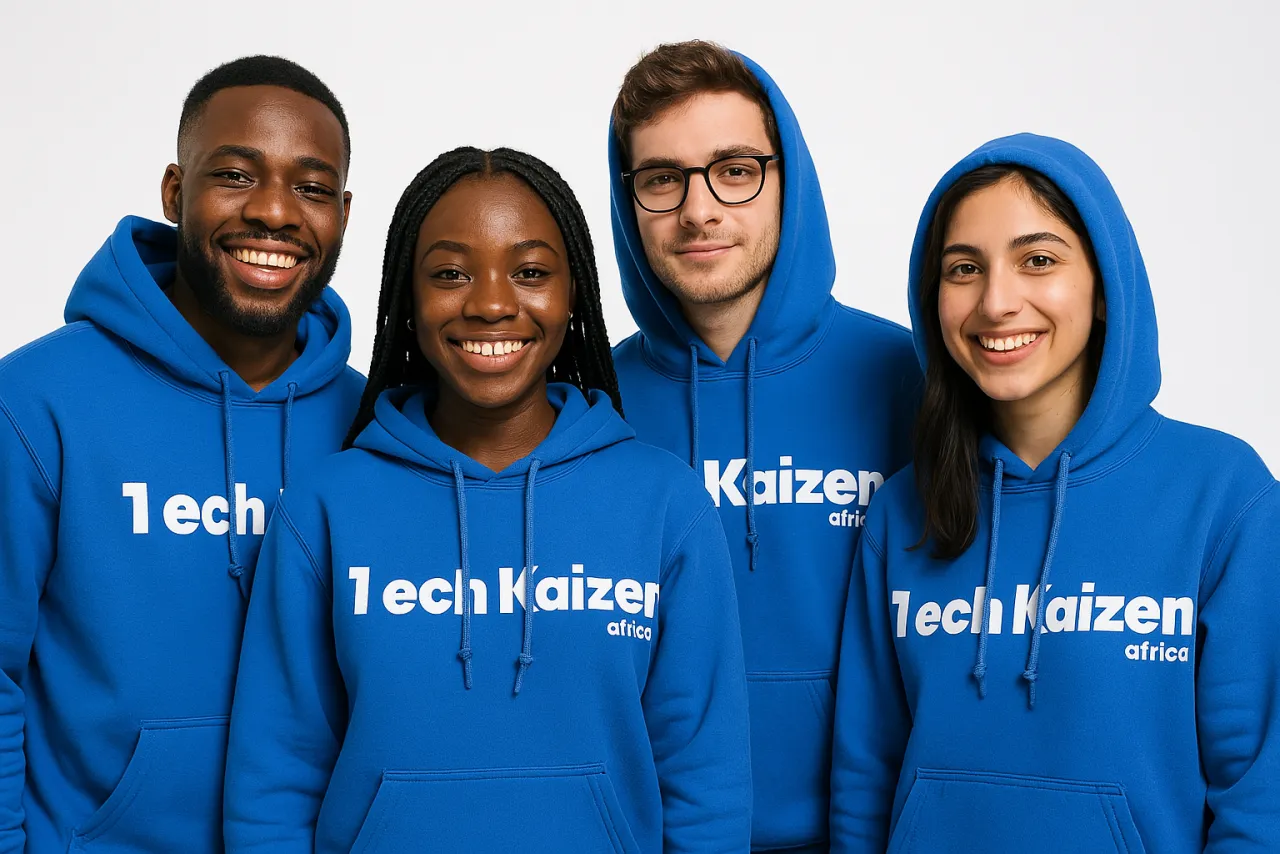
Telling powerful stories. Empowering tech talent. Driving digital transformation.
Stories, podcasts, and features spotlighting Africa's innovators and emerging trends.

Connecting global companies with vetted African developers, designers, and data professionals.

Strategic advisory, innovation support, and product guidance for startups and businesses.
Stories and podcasts
Fresh blog posts, interviews, and podcast episodes from the Tech Kaizen desk.

A Tech Kaizen podcast/video conversation about self-taught growth, career reinvention, and the road to senior technical roles.
Watch Now
A reflection on why human taste, judgment, and creative direction still matter when AI tools can generate so quickly.
Read More
How Design Futures shaped a career, sharpened creative direction, and opened new ways to think about technology and life.
Read MoreNeed help turning ideas into scalable solutions? We offer technology strategy, digital product planning, and innovation consulting tailored to Africa's fast-changing landscape.
Talk to a ConsultantWe collaborate with forward-thinking companies, NGOs, and community organisations across the world.
Tech Kaizen
 EO Robotics
Access our curated collection of free learning platforms, courses, and community programs to help you grow your tech career.
Explore ResourcesJobs and programs
Curated jobs, grants, scholarships, competitions, and startup programs for the Tech Kaizen community.
Renaissance Philanthropy / The Learning Agency
The 2027 Tools Competition supports technology, data and learning-science solutions that improve education and workforce outcomes. Worldwide applicants can enter the Strengthening Teaching, Reimagining Assessment, and Building Better Datasets tracks. The Postsecondary Learning and Work track is limited to U.S.-based entrants serving U.S. learners. Prize levels are US$50,000 for Catalyst projects, US$150,000 for Growth projects, and US$300,000 for Transform projects. Building Better Datasets entries are eligible for a US$100,000 prize. Initial abstracts are due October 13, 2026.
Location: Worldwide for eligible tracks
Deadline: Oct 13, 2026
BongoHive and Garage48
GreenCode Hackathon is a 48-hour rapid-prototyping programme for people who want to turn green and technology ideas into practical ventures. BongoHive and Garage48 are bringing together 100 participants in Lusaka to build technology-driven responses to environmental and economic challenges. The programme is supported by ESTDEV – From the People of Estonia. What participants will do Participants will work through Garage48's rapid-prototyping process, including idea validation, product development and pitching. Applicants may arrive with an early-stage concept or join a team and build during the event, with guidance from local and international mentors. Support and awards Six winning teams will share a total award fund of €6,000 and receive follow-on support from Garage48 and BongoHive. Participants will also connect with the wider Twin Digital Foundry programme and its pre-seed ecosystem. Programme dates and location The hackathon runs from 30 October to 1 November 2026 in Lusaka, Zambia. Application deadline The live registration form says applications must be completed by 15 October 2026. BongoHive's official LinkedIn announcement gives 20 October 2026. To help applicants avoid missing the opportunity, Tech Kaizen uses 15 October 2026 as the safer deadline. Neither source states a closing time, so applicants should submit early. How to apply Complete the official GreenCode Hackathon Zambia registration form. The organiser estimates that the form takes about five minutes.
Location: Lusaka, Zambia
Deadline: Oct 15, 2026
KijaniSpace
The KijaniSpace Space-IoT Innovation Programme supports up to five East African SMEs and start-ups to improve an existing agriculture-related product, service or application using Copernicus Earth Observation data, Internet of Things tools and other Space-IoT Box resources. The programme focuses on climate-smart crop farming, fish farming and related applications in the Great Lake Victoria Basin. What selected teams receive • Up to €5,000 for eligible costs linked directly to the approved innovation experiment. • Access to Space-IoT Box resources, datasets, tools and documentation. • Technical training in Copernicus, Earth Observation and IoT resources. • Business development support, mentoring and pitch preparation. • Product and market validation with users and customers. • An in-person final showcase in Kenya. The grant is paid in two stages: 20% as pre-financing and the remaining eligible amount after the final report and deliverables are approved. Funding may cover approved testing, product improvements, new Copernicus or IoT-enabled features, data collection, user validation, technical documentation and participation in programme activities. Costs must follow the sub-grant agreement. Programme and selection process Applicants propose an experiment that explains the climate-smart agriculture challenge, how Copernicus and Space-IoT resources will improve the existing solution, the planned outputs, the value to users in the target countries and a realistic budget. Proposals first receive completeness and eligibility checks, then three evaluators score excellence, impact and implementation. Tied scores are resolved through a consensus meeting, and all applicants are informed of the outcome. Training and business development support are scheduled for January to February 2027, experiment implementation and validation continue into May 2027, and the final showcase and reporting close by June 2027. Deadline note KijaniSpace's LinkedIn announcement states 16 October 2026 at 16:00 East Africa Time, while the official programme webpage currently displays 16 November 2026 and also contains a January 2027 call timeline. Tech Kaizen lists 16 October 2026 at 16:00 EAT as the safer deadline. Applicants should submit by that earlier time and check the organiser's page for any correction. How to apply Use the official proposal template, prepare the proposal in English as a PDF and submit it through the online form linked from the KijaniSpace programme page. Email applications are not accepted.
Location: Kenya, Uganda and Tanzania; final showcase in Kenya
Deadline: Oct 16, 2026
Abdul Latif Jameel Poverty Action Lab (J-PAL) / Project AI Evidence
The PAIE Scholars Program supports researchers in low- and middle-income countries in Africa and Asia to develop rigorous, policy-relevant evaluations of artificial intelligence applications for social good and poverty reduction. It is run through Project AI Evidence at the Abdul Latif Jameel Poverty Action Lab (J-PAL). Selected scholars will complete structured training in randomised evaluation and the evaluation of AI-enabled interventions. The programme includes selected J-PAL 102x modules, AI evaluation resources, live online workshops and a PAIE-administered proctored assessment. The initial training is expected to run from November 2026 to January 2027, with an estimated commitment of four to ten hours per week. Scholars who complete their assigned training, pass the assessment and submit an acceptable revised concept note will receive US$1,000. A competitive subset may then receive up to US$10,000 for proposal development and travel, alongside possible research mentorship. Eligible scholars who progress to the pilot stage may compete for up to US$75,000 in pilot funding. Applicants must submit a CV, one to three research examples, brief statements on their research and quantitative experience, and a working concept note for an AI-enabled intervention that could lead to a randomised evaluation. A fully developed project and implementing partner are not required at the initial application stage. Progression between stages is competitive. Selection for the first cohort does not guarantee proposal-development support, mentorship or pilot funding. The proposal-development grant cannot fund human-subject research or data collection from research participants. Applications close on 16 October 2026 at 12:00 ET (16:00 UTC).
Location: Eligible low- and middle-income countries in Africa and Asia; online training
Deadline: Oct 16, 2026
Paid Monthly Briefing
A premium magazine and newsletter covering African technology, startups, talent, opportunities, and digital transformation.
View Magazine